
Private Capital and European Football
Exploring how private equity is transforming European football, from Atlético Madrid’s record deal to league-wide investments, and what it means for clubs, fans, and the future of the sport.
Kyriakos Lykourgos
12/18/20252 min read
A Business Model in Transition
European football has been edging toward outside investment for years. The continuously rising costs, uneven ownership structures, and the suffocating pressure to outcompete your rivals created a simple financial reality: many clubs needed capital that traditional financing couldn’t provide. Private equity has filled that gap by offering a source of liquidity that the sport had struggled to access.
At this point, private investment is no longer unusual. It is part of the operating environment.
A Different Kind of Deal: Atlético de Madrid
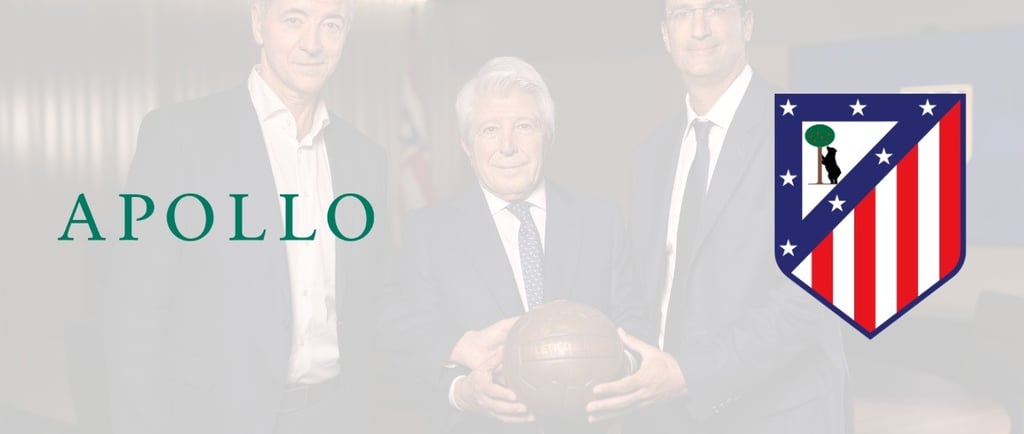
The recent agreement between Apollo Sports Capital and Atlético de Madrid is a clear indication of where the market is heading. Apollo plans to acquire roughly 55% of the club in a deal valuing Atlético at about €2.5 billion. It is expected to close in early 2026 and would make Apollo the majority shareholder.
The financial scale is significant, and the funding will support a broader commercial plan built around facilities, media, and real estate (including a new sports and entertainment district next to the Metropolitano stadium). The club is being positioned as a global brand with multiple income lines, which can be leveraged effectively by a fund of this caliber.
How Private Investors Look at Football
Private equity firms are not solely drawn to matchday income or local ticket sales. What interests them are repeatable revenue sources and assets that can be developed beyond the pitch. For elite clubs, that usually means four areas:
Media rights – Global sports broadcasting is projected to grow strongly through the next decade, and European football remains a premium property.
Sponsorship and licensing – Major clubs sell association. Commercial partners care about worldwide reach, in combination with local presence.
Digital output – Clubs are constant content producers, and digital channels create measurable revenue streams and data assets.
Real estate – Modern stadiums produce year-round commercial activity, from hospitality to retail to events.
The common thread is that clubs are being valued less like sporting organisations and more like diversified entertainment companies.
The Limits of the Model
Private equity brings structure and capital, but it also introduces pressure. Football carries risks that are difficult to smooth out on a spreadsheet:
Time horizons – Funds operate on relatively short investment cycles. Football performance, infrastructure returns, and community credibility move more slowly and with fluctuations.
Revenue volatility – Media rights are resilient but not guaranteed. Sponsorship depends on sporting relevance. Participation in Europe affects yearly budgets heavily.
Supporter expectations – Fans are sensitive to pricing, scheduling, and identity changes. If commercial priorities override community credibility, there may be major erosion of support.
Regulatory friction – Multi-club ownership has triggered scrutiny from UEFA, particularly regarding participation in European competition. National leagues are adjusting financial-stability rules in response to investor failures.
These constraints do not stop investment, but they shape the pace and structure of deals. Increasingly, investors are favouring secured lending or hybrid structures rather than pure control.
Where This Leaves the Sport
The question of whether private equity belongs in football is already outdated. It is already there. The more relevant issue is how the sport manages the transition from local institution to global entertainment franchises.
If handled well, investment can modernise infrastructure, expand international reach, and professionalise operations. If mismanaged, it can undermine competitive balance, distance clubs from supporters, and create financial vulnerabilities that outlast any investor’s timeline.
Nothing about this shift guarantees a specific outcome. It simply formalises a reality: European football now operates in the same capital markets as every other large-scale entertainment business. The challenge is to preserve the sporting and social value of clubs while allowing them to function at the economic scale they already occupy.